A history of corsets, told through what they were made of
Five centuries of corsetry read as construction rather than fashion: baleen, coutil, spring steel, the split busk and the metal eyelet — and which of those changes actually changed the garment.
Almost everything written about the history of the corset is about what it meant: whether it oppressed women or armoured them, what it said about the century that produced it. Those are real questions and I am not the person to settle them.
So this is a history of corsets read as construction, which is the one thing I can do better than a historian. I have made corsets since 2001 and manufactured them since 2005, and when I look at a corset in a museum case I see decisions about materials before I see a silhouette. What each era used, how it was assembled, and which changes actually changed the garment rather than only how it looked.
What makes a corset a corset
Before any history, a definition, because the word is used very loosely and most of the confusion downstream comes from that.
A corset reshapes the torso by applying tension through a rigid internal structure. Take away the rigidity and you have a bodice; take away the tension and you have a structured top. Both are perfectly good garments, neither is a corset, and much of what is sold as one today is one of the two.
I have written elsewhere that the pattern is not the corset, and that argument is the foundation of everything below. A corset is four systems working at once:
- The pattern, which decides where the seams fall and how circumference is distributed around the body.
- The rigid elements — baleen, cane, wood, or steel — which resist the load rather than transmit it.
- The layers, their fibre and their order, which carry the tension between the rigid elements and hold the whole thing together under friction.
- The waist tape, a band running the circumference at the waist, which takes the highest load in the garment so the shell fabric does not have to.
Read the history through those four systems and one thing emerges that the silhouettes hide: the corset changed most sharply not when fashion changed, but when the materials did.
Pairs of bodies: the 1500s and 1600s
The garment we would recognise as a corset arrives in the sixteenth century, and it was not called a corset. It was a pair of bodies — the plural is original, from the two halves laced together — and later a pair of stays.
Construction was layered and hand-built. Several plies of linen or canvas, sometimes with a silk outer, were stitched together and then stiffened. The stiffening was whatever was locally available and would hold a plane under compression: reeds, split cane, thin wooden slats, and increasingly baleen, taken from the upper jaw of baleen whales. Baleen is often called whalebone and is not bone; it is a keratin structure, and its useful property is that it holds a shape while retaining some spring, which is very close to what a modern spiral steel does.
The channels holding those stiffeners were sewn by hand in parallel rows, and their density is what a maker notices first: a sixteenth-century pair of bodies can carry dozens of channels across one front panel. That is not decoration. With no elastic component anywhere in the garment, rigidity had to come from sheer density of boning, at enormous labour cost.
The front was stiffened further by a busk: a flat strip of wood, ivory, horn or baleen, carved thin, slid into its own channel and held by a lace. It was removable, which is why so many survive independently of their garments, often carved or inscribed.
Fully boned stays: the 1700s
The eighteenth century took the same materials and pushed the technique to its limit. Fully boned stays are exactly what the name says: the entire garment is channel and bone, edge to edge, with almost no unsupported fabric anywhere.
The target shape was conical — a smooth inverted cone from underbust to waist, the bust raised and flattened rather than separated. This is where the eighteenth century differs most from the nineteenth, and where most modern reproductions go wrong. Stays do not create a waist by compressing one. They create a torso of even taper, and the waist reads as small because everything above it is conical.
Structurally that has consequences. An even taper distributes load along the whole length of the garment rather than concentrating it at one circumference. Stays of this period generally lace at the back, often with a single lace in a spiral rather than the crossed lacing that came later, and the eyelets are hand-worked — stitched holes, reinforced with thread, in fabric.
That last detail governs everything else. A hand-worked eyelet in linen will fail before the fabric around it does if you pull hard enough. You cannot achieve extreme tension through a hand-sewn hole. The eighteenth century did not tight-lace, and it is more accurate to say it could not than that it chose not to.
The split busk and the metal eyelet: the 1800s
Two pieces of metal hardware changed the corset more than any fashion of the nineteenth century did — more, I would argue, than anything else in its history.
The first is the metal eyelet. The V&A dates its invention to the 1820s; Norah Waugh, in Corsets and Crinolines, dates its effective application to 1828. [VERIFY: a named patentee and patent number for the metal eyelet — could not source one from a reliable reference.] The significance is mechanical and it is total. A metal eyelet transfers lacing load from the threads of the fabric into a metal ring that spreads it around its circumference. Before it, the lace pulled directly on cloth. After it, the fabric was no longer the weakest point in the lacing system.
Every later development follows from that. The tight-laced Victorian silhouette is not a change in taste that technology then served. It is a change in hardware that made a previously impossible tension achievable, which taste then found a use for.
The second is the split busk — a two-part steel busk with studs on one side and loops on the other, closing the centre front without unlacing. The Fashion Institute of Technology's Fashion History Timeline records that by 1850 the rigid one-piece busk had been replaced by the steel front-opening type, and names no inventor. [VERIFY: the split busk is very widely attributed to the French corsetier Jean-Julien Josselin in 1829, and its American popularisation to a Joseph Cooper patent of 1848, but I could not confirm either from a museum or academic source — only from secondary and tertiary web sources that appear to share an origin.]
Whoever made it, the consequence is not really convenience. A front opening means the back lacing no longer has to be slackened and retightened each wearing: it can be set once and left, and the corset gains a second independent adjustment system. That is a structural change dressed up as a convenience.
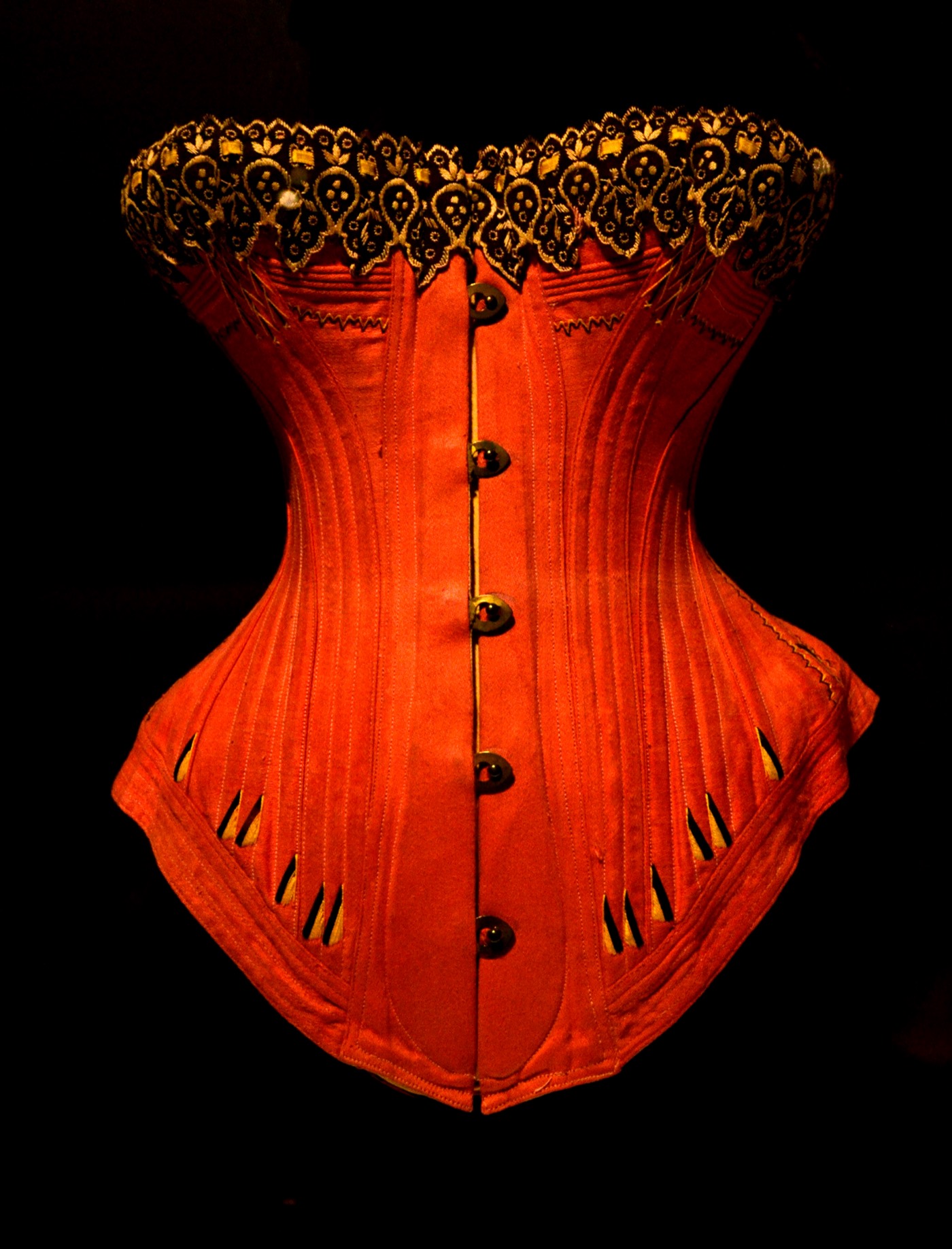
Coutil and steam: the Victorian corset
By the second half of the nineteenth century the corset is an industrial product, and the materials tell you so.
The characteristic fabric is coutil: a tightly woven cotton, usually in a herringbone or broken twill, engineered specifically for corsetry. Its virtue is dimensional stability. A plain-woven cotton stretches on the bias, and a garment under permanent tension will find that bias and distort along it. Coutil's tight herringbone structure resists distortion in every direction at once. It is one of the few textiles I can think of that was developed for a single garment type and is still, more than a century later, the correct answer for it.
The second development is gored panels. Rather than shaping the torso only through the seams between vertical panels, makers cut wedge-shaped gores into the panels themselves — over the bust and over the hip — to add circumference where the body needs it without adding a seam. This is real pattern engineering, and it is the direct ancestor of how a modern corset block is developed.
The third is steam moulding. The V&A credits Edwin Izod with developing it in the late 1860s; it is commonly given as 1868. The corset was starched, dampened, and set on a steam-heated copper torso form until it dried into that shape. The V&A holds an Izod wedding corset of 1887 made this way.
Steam moulding is often described as a shaping technique on a par with pattern cutting. It is not. It sets fabric and boning into a shape they have already been cut to approximate, removing the break-in period and producing a smoother garment. It does not fix a bad pattern, and in my experience nothing downstream of the pattern ever does.
The S-bend and the health corset: the Edwardian years
The Edwardian corset is the one era where I think the construction record is genuinely misunderstood, and the misunderstanding is worth correcting because it runs opposite to the usual story.
The straight-front corset was designed by Inès Gâches-Sarraute (1853–1928), who had medical training and set out the design in her 1900 book Le corset: étude physiologique et pratique. Her aim was corrective. She introduced a rigid straight busk at the centre front intended to support and raise the abdomen rather than compress it, specifically to reduce the pressure that conventional corsets placed on the organs of her patients. The Fashion History Timeline is explicit that these were conceived as medical devices, not fashion garments.
The S-bend silhouette — bust thrown forward, hips thrown back — was not what she designed. It was what happened when the design was taken up commercially, cut for effect, and laced to extremes she had not intended. A corset conceived to reduce abdominal pressure became the signature of the most contorted decade in the garment's history.
As a maker I find that the most instructive episode in the whole history, because it is still true: the structure of a corset does not determine how it will be worn. You can engineer a garment to distribute load correctly and still have it pulled into a shape you did not design.
Why the corset collapsed: the 1910s and 1920s
The corset did not fall out of favour gradually. It collapsed as a category within about fifteen years, and the reasons are structural before they are cultural.
The first is that its function was unbundled. A corset did two jobs at once, supporting the bust and shaping the waist. Herminie Cadolle showed a two-part garment she called the corselet gorge in Paris in 1889, the upper part carried on shoulder straps; in 1914 Mary Phelps Jacob patented a backless brassiere in New York. Once bust support is a separate garment, a corset does half a job for all of its weight and cost.
The second is materials. Knitted elastics made possible a garment that shapes without rigid structure — the girdle, which compresses without boning, needs no lacing, and requires no skill to put on.
The third is the story everybody repeats, and it needs care. In 1917 the chairman of the United States War Industries Board, Bernard Baruch, asked American women to stop buying corsets in order to conserve steel. That request is well attested. The figure attached to it — that 28,000 tons of steel were freed, enough for two battleships — is repeated everywhere, including by outlets that later corrected the battleship comparison. [VERIFY: the 28,000-ton figure and the battleship comparison — I could not trace either to a primary source or a contemporary document, and every secondary source I found repeats it without citation. Treat as unverified.]
My own read, as someone who has watched what actually moves a corsetry market: the war request is a good story, and the brassiere and the elastic girdle are the real explanation. A garment does not disappear because of a wartime appeal. It disappears because something cheaper does most of its job.
The New Look and the waspie: 1947 onward
The corset returns as a specialist garment rather than a universal one, because a silhouette demanded a structure elastic could not give.
Marcel Rochas introduced a short, strapless waist-cinching garment in 1945, the guêpière in France and the waspie in Britain and America. In February 1947 Christian Dior showed his first collection, Corolle, whose Bar suit gave the New Look its name: narrow shoulders, a sharply defined waist, a full skirt. That waist was not achieved by cutting but by boned foundation garments worn underneath.
The waspie carries a real construction lesson. It is short, so it has very little length over which to distribute load; everything concentrates in a narrow band. That makes the waist tape and the grade of the boning disproportionately important, and it is why a badly made waspie fails faster than a badly made full-length corset. There is nowhere for the load to go.
Modern corsetry: what I make now
A well-made corset today would be recognisable to a Victorian corsetière in every respect except the metallurgy and the pattern grading.
The boning is two kinds of spring steel and they are not interchangeable. Spiral steel, coiled from flat wire, flexes in every direction, which is what lets it follow a waist and a ribcage that are moving. Flat steel resists in a single plane, which is what keeps the lacing panel straight so tension pulls evenly instead of twisting the garment. Spiral goes around the body; flat goes either side of the lacing and beside the busk. Put them the wrong way round and the back panel bows or the corset fights the wearer.
The closure is a two-part steel busk, essentially the nineteenth-century design, or a zip. Both are legitimate; the absence of a real closure system is not.
The shell is coutil or a firm cotton twill. The lining is one hundred per cent cotton — not for tradition, but because it is a structural layer under constant friction against skin, and a synthetic will slip, hold heat and abrade where it is compressed hardest. The waist tape is still a band at the waist, still invisible when finished, still the first component omitted when a corset is made down to a price.
Two things are genuinely new. The first is CAD pattern grading, which lets a block be developed once and graded across a size range with a consistency hand grading cannot match at volume — the largest change in how corsets are produced since the sewing machine. The second, in my own case, is that the hardware is not bought in. When I started, corset hardware was almost impossible to source in India, so rather than accept someone else's specification I built the supply: the spiral bones, flat bones and busks in our corsets are made in-house.
Almost no corset manufacturer anywhere makes its own steel; most buy from the same small group of suppliers, which is why corsets from very different brands often behave identically. The practical consequence is narrow but real: when a pattern needs a bone to behave differently, I can change the bone instead of compromising the pattern.
A timeline of corset construction
| Period | Name | Structure | Material | Closure |
|---|---|---|---|---|
| 1500s–1600s | Pair of bodies | Dense hand-stitched channels; separate front busk | Linen and canvas; reed, cane, wood, baleen | Lacing through hand-worked eyelets |
| 1700s | Stays | Fully boned edge to edge; conical taper | Linen and canvas; baleen; leather binding | Back lacing, hand-worked eyelets |
| 1800s to 1850 | Corset | Fewer, wider channels; shaped panels | Cotton and silk; baleen giving way to steel | Metal eyelets; two-part steel busk |
| 1850s–1890s | Victorian corset | Gored panels; steam moulded; machine sewn | Coutil; spring steel | Split busk and back lacing |
| 1900s–1910s | Straight-front or S-bend | Long rigid front busk; deep hip gussets | Coutil and cotton twill; spring steel | Split busk and back lacing |
| 1920s–1930s | Girdle; brassiere | Compression without rigid structure | Knitted elastic; little or no steel | Step-in, hook, or none |
| 1947–1950s | Waspie or guêpière | Short; load concentrated at the waist | Coutil, satin, power net; spring steel | Zip, hooks, or busk |
| Today | Corset | Four systems: pattern, steel, layers, waist tape | Coutil or cotton twill; cotton lining; spiral and flat steel | Two-part steel busk or zip, with back lacing |
What is the difference between stays and corsets?
The same category of garment under two names from two periods — but the construction difference behind the names is real.
Stays is the term through roughly the seventeenth and eighteenth centuries; corset displaces it in the early nineteenth. Stays produce a conical taper, distributing shaping along the whole garment, boned at very high density with baleen. Corsets produce a defined waist, concentrating shaping at one circumference, using fewer and wider bones, curved panels and gores.
The change of name tracks the change of hardware. Once metal eyelets and a two-part busk existed, the garment could do something stays could not, and it took a new word for it.
Who invented the corset?
Nobody, and any page that gives you a name is selling you something.
The corset has no single inventor. It emerged in the sixteenth century as stiffened bodices across several European courts, developing out of existing garment traditions rather than appearing as an innovation. There is no first corset, no patent, no founding maker.
Specific components can be attributed, and even there the record is thinner than most sources admit. Steam moulding is credited to Edwin Izod in the late 1860s, the straight-front corset to Inès Gâches-Sarraute in 1900. The metal eyelet and the split busk — the two that mattered most — cannot be reliably attributed to anyone from the sources I can check.
Did men wear corsets?
Yes, and the evidence is not only documentary.
Men's corsets are recorded through the nineteenth century, worn for posture, military bearing, slimming, and after injury. They are constructed identically to women's garments of the same period — same coutil, same steel, same busk and lacing — differing mainly in the block, which is straighter through the torso with less waist reduction.
The skeletal record supports it independently: a nineteenth-century British male skeleton has been examined showing the rib changes associated with long-term corset wear. The assumption that corsetry was exclusively a women's garment is a later simplification.
Were corsets really dangerous?
This deserves a careful answer, because both the popular version and the corrective version are wrong.
The most lurid claim, that women had ribs surgically removed to achieve smaller waists, is not supported. Valerie Steele, in The Corset: A Cultural History, found no medical documentation of elective rib resection for this purpose. It is a story that circulated in the nineteenth century and has been repeated since, and there is no evidence behind it.
But the corrective position — that corsets were harmless — overshoots in the other direction, and the physical evidence does not support that either. Tight-lacing at extremes had measurable effects. Steele worked with a cardiologist to demonstrate that tight-lacing reduced lung capacity, sufficient to produce shallow breathing and occasional fainting. And in a 2015 study in NEXUS: The Canadian Student Journal of Anthropology, Rebecca Gibson examined skeletal remains from the Musée de l'Homme in Paris and the Centre for Human Bioarchaeology at the Museum of London against corsets in the V&A dated 1750 to 1908, and found rib deformation and vertebral changes consistent with sustained compression during skeletal development. Ribs pushed toward an S-curve and vertebral spinous processes deviated from vertical are not myths; they are measurable in bone.
The finding people miss is the last one. Gibson also found that the corseted women in her sample lived longer than the average for their period, which makes the standard picture of corsetry as a cause of short and painful lives difficult to sustain. Gibson has since published a critique of methodological and historical inaccuracies in the bioarchaeology of corsets, so this is an area where the evidence is still being argued over rather than settled.
My own position, and I flag it as opinion because that is what it is: the honest summary is that sustained extreme tension during skeletal growth deformed bone, and that this is a genuine harm, and that it is not the same claim as the organ-crushing and rib-removal stories, which are not supported. A garment that redistributes load can be worn badly. That is true of a corset and it is true of a shoe.
Nothing in this page should be read as advice to wear a corset for waist reduction. I make corsetry; I do not recommend waist training and I have nothing to sell you here.
Why did women stop wearing corsets?
Because a cheaper garment did most of the job, not because of any single event.
Three things happened close together. The brassiere separated bust support from waist shaping. Knitted elastic made the girdle possible, which shapes by compression and requires no skill to put on. And the First World War disrupted both materials and the domestic labour that daily back-lacing had quietly depended on.
The most repeated version of this story is the wartime steel appeal, which did happen. As a maker I would put it last of the three. Corsetry is a skilled, expensive, slow product, and it lost to a fast, cheap, unskilled one. That is nearly always how these things go, and it has little to do with the war.
What changed and what didn't
Five centuries, and here is what a maker actually sees.
What changed is hardware. The metal eyelet moved the lacing load off the fabric and into metal. The two-part busk gave the garment a second independent adjustment. Spring steel replaced baleen. The sewing machine, then CAD grading, turned a bespoke object into a graded product. Those four are the whole story, and none of them is a fashion.
What did not change is the principle. A corset still works by resisting load through rigid elements while the layers hold the tension between them, and it still fails at the waist first if nothing is built to take the load there. A sixteenth-century maker packing baleen into hand-stitched channels and I are solving the same problem with different materials. That a garment made in 1600 and one made in my factory this week answer to the same four systems is the most interesting thing about the object.
The materials got better. The problem stayed exactly where it was.