Suman Bharti
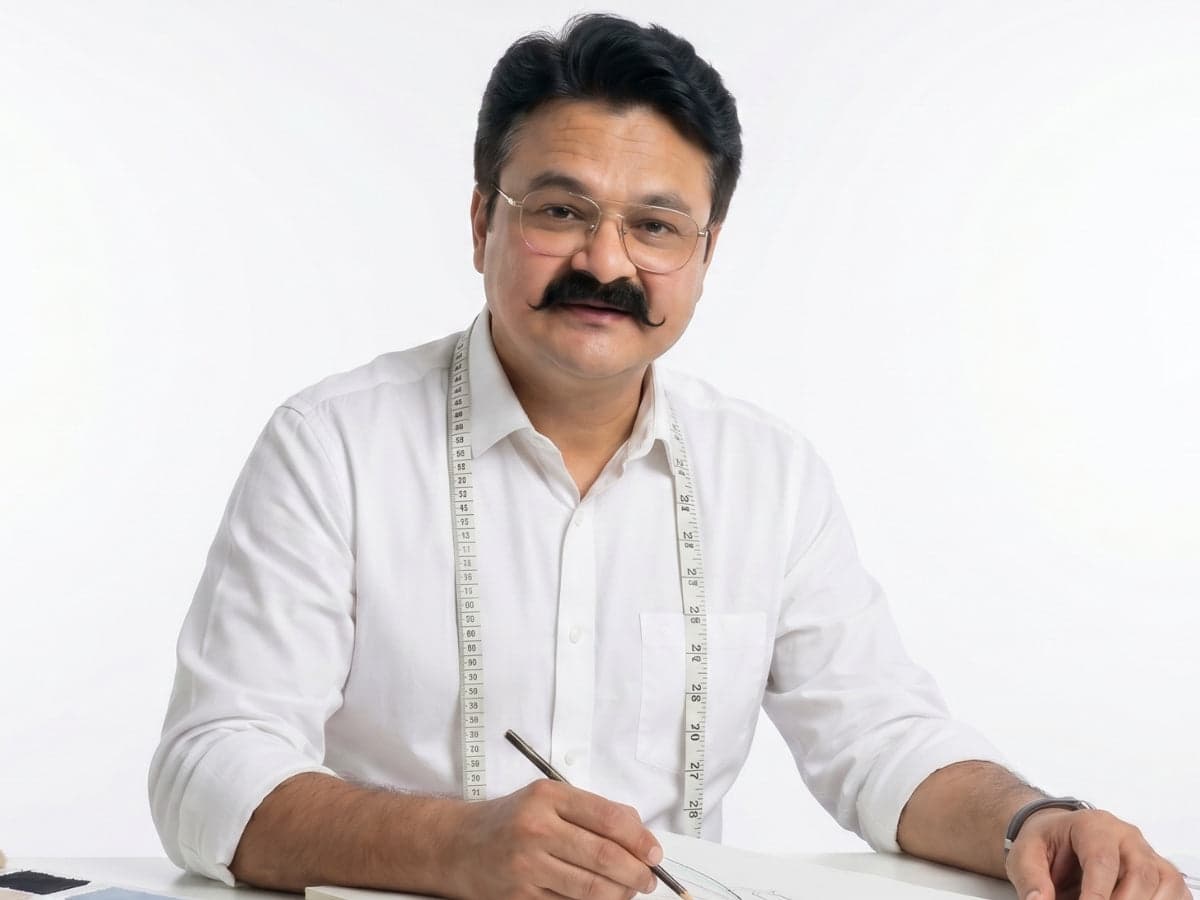
Fashion designer for 25 years, in corsetry for 21 of them. Trained at Pearl Academy of Fashion, where his graduation collection won the Best Innovative Collection Award. Founded Corset Wholesale Ltd in Gurugram, India in 2005.
Ranchi
I was born in Ranchi, in what was then Bihar and is now Jharkhand.
I was on the creative side of things from the start. School didn't hold much of my attention, with one exception: history. It was my best subject and the only one I'd have kept studying if nobody had made me.
I didn't know then that it was training for anything. Corsetry turned out to be a historical discipline before it was a fashion one — the patterns are inherited, the construction logic was worked out in the nineteenth century, and you cannot improve on something you haven't first understood. The patience for primary sources isn't a skill I acquired later. It was already there.
Pearl Academy, 2001
I graduated from Pearl Academy of Fashion in 2001. My final collection won the Best Innovative Collection Award.
There were corsets in that collection. That wasn't the obvious choice for a graduating student in India in 2001, and it happened because of my mentor at Pearl, Ashish Gupta — a designer whose work has since been exhibited at the V&A in London and the Met in New York, and who has won the British Fashion Council's NewGen award three times. He taught me to read historical garments properly: not as costume or reference, but as engineering that had already solved problems I hadn't yet learned to see.
Twenty-five years later I'm still working on the question that collection opened.
The family business
For two years after graduating I worked in the family business.
It was not fashion, and I have no romantic account of it. What it gave me was the part of this trade that design school does not teach: how money actually moves through a small business, what a supplier relationship is worth, and how quickly a good idea dies without the operational discipline underneath it.
I have used that more than I have used anything I learned about draping.
London, 2003
I moved to London in 2003 to work as a designer.
Twenty-one companies turned me down.
I want to be plain about that, because the tidy version of this story would skip it. I had a strong portfolio, an award, and an education. It didn't matter. I was an Indian graduate with no UK experience applying into a market that had no particular reason to take a chance on me, and it did not take one.
What I got instead was two years of looking at the industry from the outside, which is the only vantage point from which you can see what it isn't doing. The gap I kept noticing was corsetry. There were corsets in museum cases, made properly, and there were corsets you could actually buy, made badly. Almost nothing occupied the space between. Nobody working inside the market seemed interested in closing it.
Coming home, 2005
On 1 January 2005 the WTO Agreement on Textiles and Clothing expired, and the global quota system governing textile and clothing trade ended with it.
That is a dry sentence with an enormous consequence. For four decades, quotas had capped how much a country like India could export to markets like the US and the EU, regardless of what it could make or how well. On that date the cap came off.
I understood what it meant for someone in my position: the structural barrier between a workshop in India and a buyer in London or New York had just been removed. What remained was whether you could make the thing well enough.
I came home that year.
Rs 24,000 and one machine
I started with one sewing machine and twenty-four thousand rupees.
I sold on eBay, one corset at a time, each one made by hand — my hands. A single listing, a single piece, packed and shipped. Within a short time I was an eBay Power Seller, sending corsets I had made myself to customers on the other side of the world.
I mention the twenty-four thousand rupees because people assume a factory begins with a factory. It doesn't. It begins with someone making one thing correctly, then making it again, and refusing to make it worse when the volume goes up.
Corset Wholesale Ltd was built out of that.
Building the hardware
This is the part people in the industry find hard to believe.
When I started, corset hardware was almost impossible to source in India. Spiral steel bones, flat steel bones, busks — the components that make a corset a corset rather than a structured top — all had to be imported. That meant cost I couldn't absorb, lead times I couldn't control, and specifications I had to accept as given.
So I stopped waiting for a supply chain and built one. Today the spiral bones, flat bones and busks in our corsets are made in-house.
Almost no corset manufacturer anywhere makes its own steel. Most of the industry, including names much larger than mine, buys from the same small group of suppliers — which is why so many corsets from different brands behave identically.
Making the hardware means the tolerances are mine. The tempering is mine. When a pattern needs a bone to behave differently — more spring through the underbust, more resistance at the waist — I change the bone rather than compromising the pattern. Very few people in this trade have that option, and it is the single thing about my work I would point to first.
The factory today
The one machine in a small Gurgaon workshop is now a 15,000 sq ft ISO 9001-certified factory in Gurugram, shipping to buyers in more than thirty-two countries. Somewhere past a million corsets have left it.
I have manufactured for most of the leading names in corsetry and alternative fashion. I can't tell you which ones.
That is the arrangement in private-label manufacturing, and I intend to honour it. A supplier who names his clients has told you the most important thing about himself, and it isn't the client list.
CorsetDeal becomes Luxe Noir, 2025
Alongside the manufacturing business I built a consumer brand, CorsetDeal, which grew into one of the largest online corset retailers in the world.
By 2025 the name no longer matched what it was selling. The construction had moved a long way up; the brand hadn't. So I rebuilt it for the market it had already grown into, and CorsetDeal became Luxe Noir.
Same atelier. Same designer. Two decades of fit data behind it.
Now
Year twenty-five as a designer. Year twenty-one in corsetry.
What I'm still working on is the same problem the graduation collection raised: how close a corset made at volume can get to one made by hand for one body. The honest answer is closer than the industry assumes and further than I'd like, and the distance between those two is where the remaining work is — in the pattern blocks, in the steel, and in fit data across enough real bodies to stop guessing.
I'd rather be judged on that than on anything already behind me.